Journal — Buildspace
The sidewalk came before the sensors
Digital Sidewalk began with a question about how people learn by being around one another. The instruments came later.
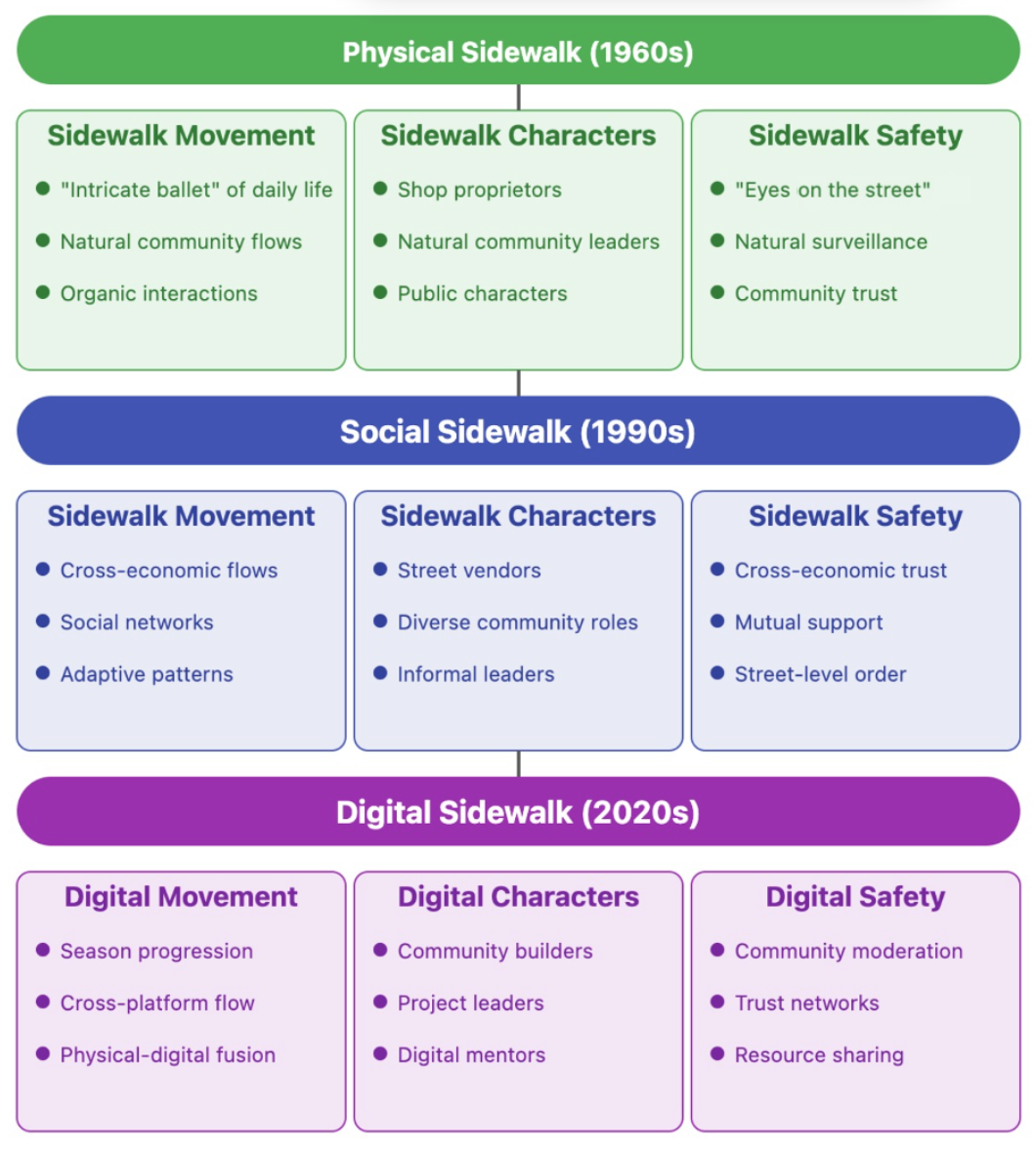
The Digital Sidewalk began as a way to understand learning that happens around a formal activity: watching another person build, asking an unexpected question, returning to a familiar group, or seeing someone work through a problem in public. Those encounters can be consequential even when nobody calls them a lesson.
The study
My doctoral research, completed at Regent University in 2025, examined Buildspace, a community whose activity moved between online platforms and physical gatherings. The framework drew on three sources. Jane Jacobs's account of everyday public life supplied the sidewalk itself: the ordinary contact between strangers that keeps a street safe and interesting. Mitchell Duneier's sidewalk ethnography supplied the method of close, patient description. Gordon Pask's account of interaction between actors supplied a language for what changes when two people exchange understanding rather than information.
The word "sidewalk" was a research metaphor with an empirical setting. It was not the name of a sensor platform. That distinction is the reason this journal exists.
What the study contributed
The 2025 conference manuscript, presented at the IEEE Digital Education and MOOCs conference, describes participant observation, interviews, digital artifacts, and field notes. Its three central dimensions are movement, characters, and safety. Together they give a vocabulary for how people circulated, how informal roles emerged, and how trust developed.
This was an ethnographic contribution. A community's overall membership is not the same thing as an interview sample, and qualitative observations should not be read as a universal causal law. The value of the work is the closely described relationship between an environment and the learning that can happen inside it.
What carries forward
Digital Sidewalk Lab carries that question into new settings: what makes a place observable, interpretable, and useful to the people participating in it? A later environmental observation project can borrow the discipline of situated attention without claiming that a thermometer measures community trust.
The framework, the Lab, and the later prototypes belong to one developing history, but each has its own claims and its own evidence. The rest of this journal shows those connections clearly enough that another person can examine them.