Journal — Method
A global sidewalk is a testable question
The global protocol asks which community conditions travel across settings, and which do not.
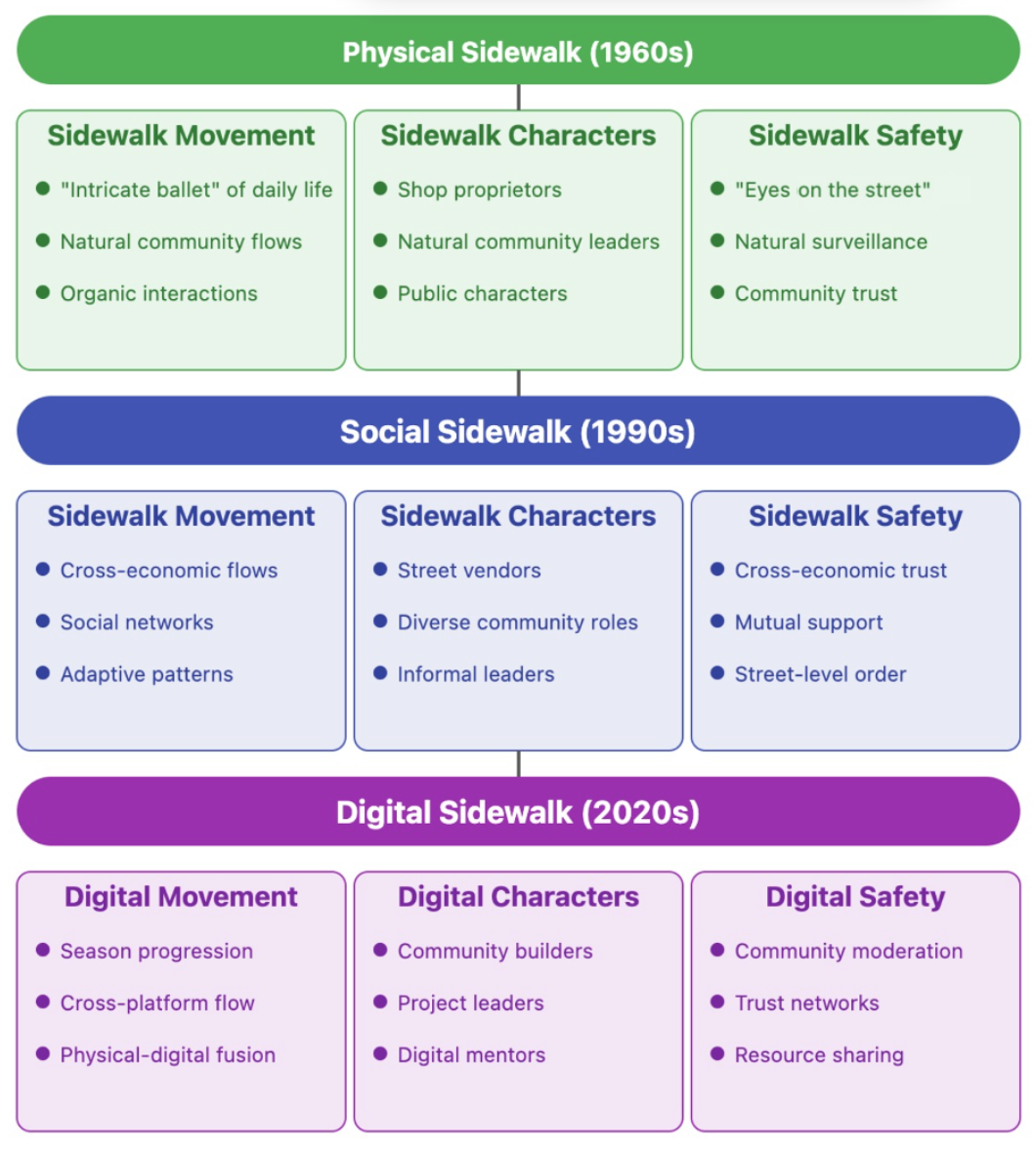
The 2025 site described a "Global Homestead Initiative." The August 2026 protocol is what that idea became once it was written as a question with failure conditions.
From a case study to comparisons
The protocol asks how the original framework might be operationalized beyond one community. Its starting point is Jacobs's account of public life, with Paskian interaction used to investigate adaptation within an environment. Candidate observations include continuity of participation, recurring low-stakes contact, informal connecting roles, multiple uses of the same space, alternative routes, and explicit governance of boundaries. These are proposed variables, not a validated global index.
Feedback, defined
Gordon Pask's work gives the framework a language for interaction rather than one-way delivery. The useful question is not whether a message arrived. It is whether the participants changed what they understood, what they did, or how they related to one another. A reply, a click, and a durable change in practice are different observations, and treating them as interchangeable would make a feedback model appear more informative than the evidence allows.
The protocol describes a candidate pathway with five parts: a source, a signal, a receiver, a relation, and feedback. In plain terms: who or what produced the information, what moved, who encountered it, what relationship shaped that encounter, and what happened afterward. It also states a limit in so many words: a social system is not literally an acoustic system, whatever the Lab's other work might tempt a reader to assume.
Keep simulation in its place
A simulation can test the consequences of declared assumptions. It cannot establish that real people behave that way because the model produces a coherent pattern. The protocol separates simulated findings from claims about human communities and proposes comparisons against simpler baselines, removal of model components to see what each contributes, held-out retrospective evaluation, and external human validation.
Avoid the single-score shortcut
The draft prohibits collapsing the first measurement phase into a universal composite score before reliability and predictive usefulness have been established. Keeping variables separate makes disagreements inspectable.
The completed artifact is the protocol. The immediate task is to choose a bounded comparison, declare what would count as failure, and preserve enough of the process for another researcher to challenge the interpretation.