Journal — Method
Atom, signal, pattern, hypothesis
In August 2026 the Lab declared a parent frame over every research thread — four levels of claim and four ledgers a claim may live in.
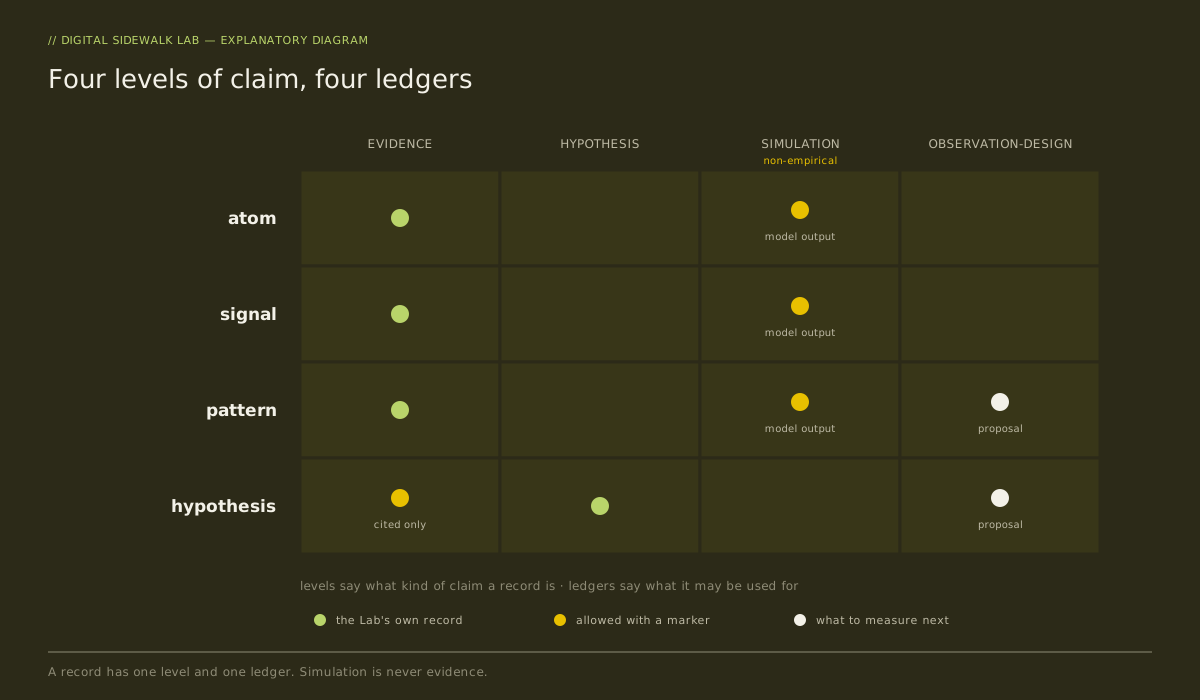
By August 2026 the Lab had several research threads that looked unrelated: storm sensing, radio and amateur-radio signal observation, a vocal-tract acoustics atlas, a cultural-diffusion case study, and an institutional-history case. On August 15 they were placed under one declared frame. Digital Sidewalk, as a research infrastructure, is a shared evidence and signal substrate. Each thread is a node: a bounded observational instrument that emits records into the substrate. What leaves the substrate goes out through governed export profiles, such as a public dataset or a paper.
Four levels
Every record carries one of four levels, which say what kind of claim it is.
An atom is one observation or one derived value, with its source, time, footprint, and rights attached. It claims nothing beyond itself.
A signal is a change worth noticing: a departure from a baseline, described with the method that defined the baseline.
A pattern is a relationship among signals, across time, places, or nodes, stated with the comparison that produced it.
A hypothesis is a proposed explanation for a pattern, stated so that something could refute it.
Four ledgers
Every record also lives in exactly one of four ledgers, which say what it may be used for.
The evidence ledger holds atoms and signals that came from the world. The hypothesis ledger holds explanations. The simulation ledger holds anything produced by a model, marked non-empirical so that it can never be mistaken for evidence. The observation-design ledger holds proposals for what to measure next.
A level and a ledger compose. A hypothesis-level record can sit in the evidence ledger only as a citation of someone else's published claim; the Lab's own hypotheses sit in their own ledger until tested.
Why declare it
Two things had happened independently. The amateur-radio work had converged on a record shape compatible with the storm-sensing schema without either being designed from the other. And the institutional-history case had shown that the disappearance of a measuring instrument can itself be a signal, which only makes sense if missingness is a first-class record. A frame that already fit two unrelated nodes was worth writing down for the rest.
The frame is descriptive. It says what a record is and where it lives. It does not, by itself, say what to measure next; that question has its own instrument, described in the next entry.