Journal — Physics
One cavity, three domains
Sound in a room, heat in a building envelope, and airflow in a duct are all energy moving inside a bounded space. The January 2026 specification treated them with one model.
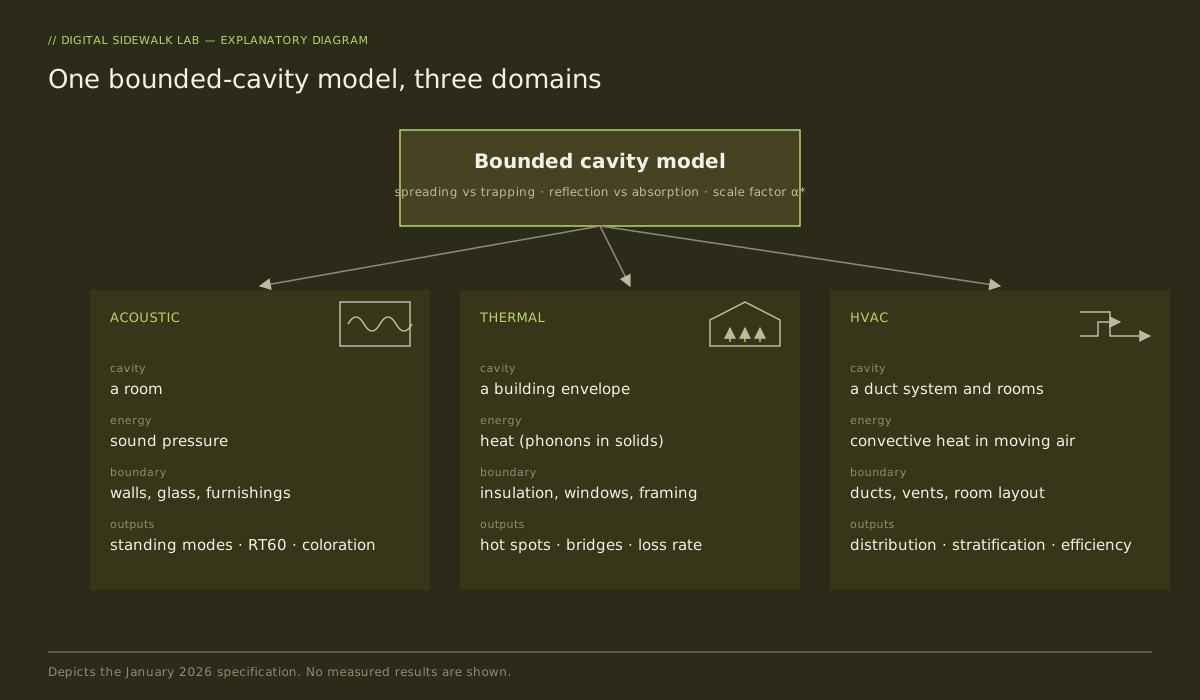
In the first week of January 2026 the Lab wrote a specification that unified three problems under one model. The model is called the Cavity Resonance Oracle. The word "oracle" here means a predictor that takes a description of a bounded space and returns how energy will distribute inside it. "Cavity" means any enclosed volume with reflective and absorptive boundaries.
Three domains
An acoustic cavity is a room. The energy is sound pressure. The boundaries are walls, floors, furniture, and glass. The outputs are standing modes, the reverberation decay time (RT60, the time for sound to fall by 60 decibels), and the coloration a room gives a voice.
A thermal cavity is a building envelope. The energy is heat, carried in solids by lattice vibrations called phonons. The boundaries are insulation, windows, and framing. The outputs are hot spots, conduction bridges at window frames and studs, and loss rates.
An HVAC cavity is a duct system and the rooms it serves. HVAC stands for heating, ventilation, and air conditioning. The energy is convective heat carried by moving air. The boundaries are ducts, vents, and room layout. The outputs are air distribution, thermal stratification (warm air pooling near ceilings), and system efficiency.
One model
The specification treats each boundary as a grating: a surface that reflects part of an incoming wave and absorbs the rest, producing interference between what arrives and what returns. The grating spacing is scaled by a golden-ratio rule, so that successive layers are spaced by a constant factor α* (alpha-star) that maximizes constructive spreading. Damping is modeled by a term the Lab calls slapback, in which the variance of the returning signal stands in for how much the material absorbs.
The claim is not that a house is a concert hall. The claim is that a small set of shared quantities, spreading versus trapping and reflection versus absorption, appears in all three, and that a model calibrated in one domain gives a usable prior in the others.
Where it came from
The thermal side came first, from work on heat spreading in stacked semiconductor dies. The acoustic side came from audio tools already in production at the company. The HVAC side came from a family trade: my father worked in heating and air, and the questions in that domain were familiar before they were mathematical.
Status
This is a design record. The specification includes a validation checklist for each domain, such as RT60 prediction within 0.2 seconds of measurement and leak detection agreeing with a professional audit at least 85 percent of the time. None of those checks had been run at the time of writing, and this journal does not report them as passed.