Journal — Method
Calibrating a fleet of strangers' phones
A citizen sensing network runs on whatever devices people already own. Blind calibration turns that from a weakness into the measurement.
The ice-storm dataset has an honest limit: its microphones were never calibrated. A network built from volunteers' phones will have that limit on every node, with a different uncalibrated microphone at each one. The August 21 protocol is the Lab's answer.
The signal model
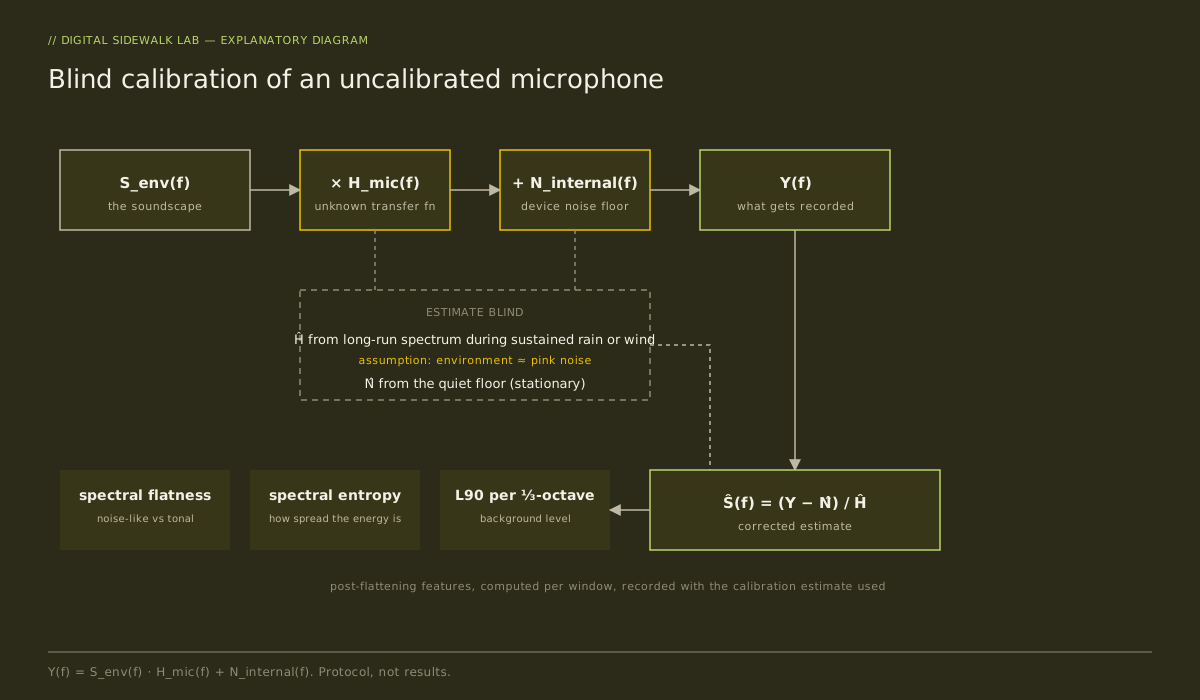
What a phone records is not the soundscape. It is the soundscape shaped by the phone. Written as a spectrum, the recorded signal Y at frequency f is the environmental sound S multiplied by the microphone's transfer function H, plus the device's own internal noise N:
Y(f) = S_env(f) · H_mic(f) + N_internal(f)
Every term is a function of frequency. H is the unknown. If H can be estimated for each device, the recording can be corrected by applying its inverse, and recordings from different phones become comparable.
Estimating the unknown blind
There is no reference microphone in a volunteer network, so H has to be estimated from the recordings themselves. The protocol uses two assumptions that hold in the situations the network cares about. During sustained rain or steady wind, the environmental sound is close to pink noise, whose spectrum falls at a known rate. And a device's internal noise floor is stationary and can be measured during quiet. Under those assumptions, the long-run average spectrum during rain reveals H up to a constant, and the quiet floor reveals N.
After correction, the protocol computes three summary features on each window: spectral flatness, a measure of how noise-like versus tonal a spectrum is; spectral entropy, a measure of how spread out the energy is; and the level exceeded 90 percent of the time in each third-octave band, a standard background-noise measure written L90.
Why this is the asset
A network of identical calibrated instruments would be expensive and small. A network of uncalibrated phones is free and large, and the correction makes the size usable. That is the same problem faced by large crowdsourced noise-mapping projects, and the ecoacoustics literature already has a published protocol for equalizing dissimilar recorders. The Lab's contribution is to make the calibration a first-class field in the observation record, so that a downstream reader can see whether a value has been corrected and by what estimate.
Status
This is a protocol with prior art cited. It has not yet been run on the fleet, because the fleet at the time of writing is two devices. It will be run on the first multi-station season.