Journal — Buildspace
Movement. Characters. Safety.
Three dimensions for noticing what an activity counter cannot tell you about a community.
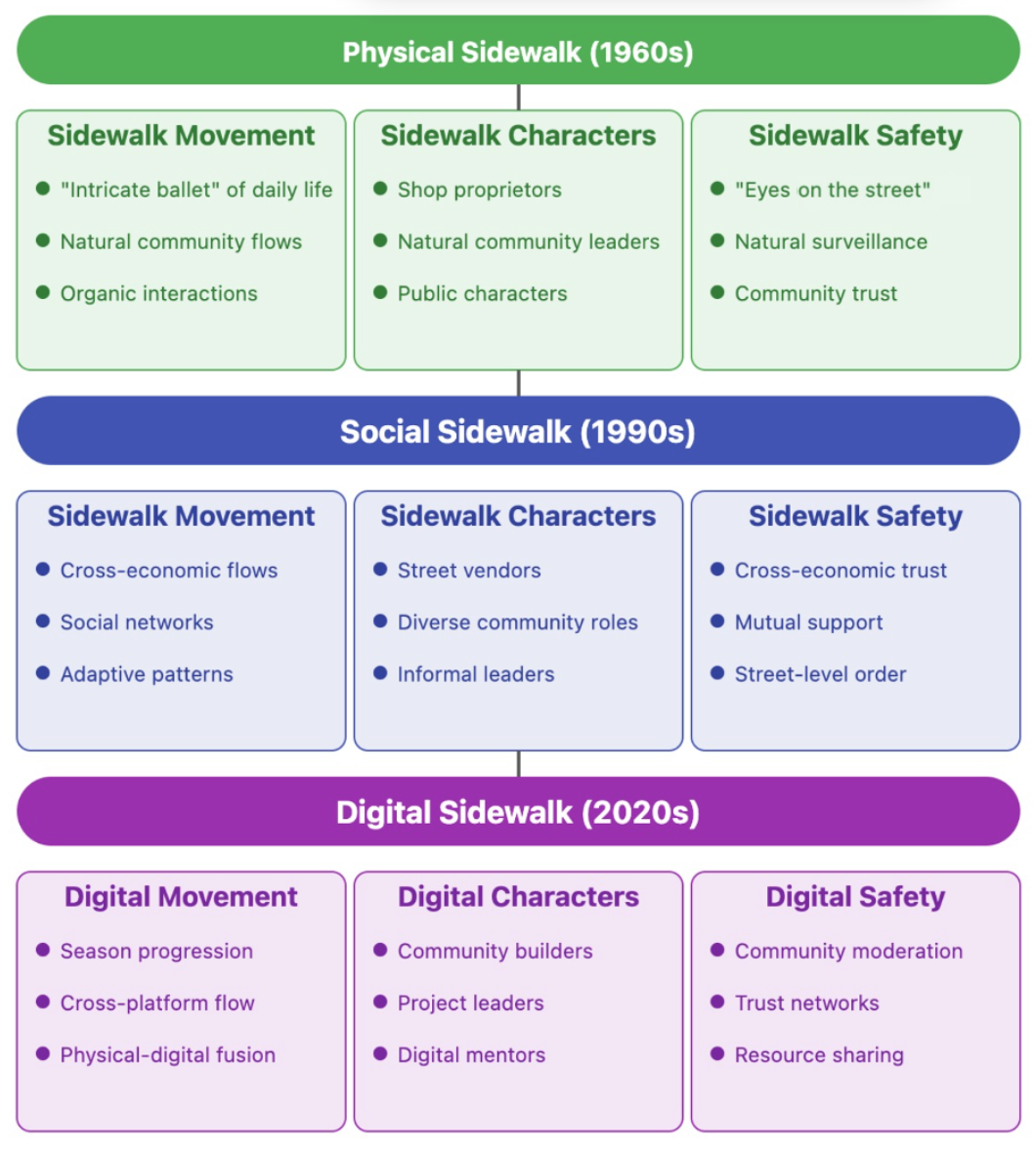
The 2025 paper names three dimensions. Each is a question to ask of a real community, not a score to compute from a feed.
Movement is more than traffic
Movement asks how participation unfolds through time and across settings. In the Buildspace study that included seasonal rhythms, movement between platforms, and encounters that connected online work to physical gatherings. A count of posts can indicate activity, but it cannot by itself explain those pathways.
For a new study, the practical question is where a person can go next: from a question to a conversation, from a demonstration to an attempt, from watching to helping. Those transitions need to be observed rather than assumed.
Characters are the people who connect a place
The framework uses "characters" in Jacobs's sense: recognizable public roles that arise without a title. Someone becomes an informal guide, a persistent question-asker, or the person who connects otherwise separate groups.
Studying them requires attention to repeated behavior and relationships over time. Calling every highly visible account a community leader would miss the difference between attention and useful participation. The original study offers a way to ask who helps a community make sense of itself.
Safety includes trust and accountability
Safety concerns the conditions under which people can participate, share unfinished work, exchange resources, and respond to problems. It should not be reduced to surveillance or to the absence of disagreement. The relevant evidence is how norms are maintained and how people experience participation.
Why the Lab keeps them
These three dimensions are a framework for inquiry, not a ready-made index. In the Lab's sensing work they remain a reminder to preserve context. A map, a feed, or a program is used by people with different roles and expectations; evaluating the infrastructure means attending to those relationships as well as to its technical performance.